UEW on the Right Path to Global Visibility – THE Regional Manager



Mr. Victor Okeugo, Regional Manager for Sub-Saharan Africa at Times Higher Education (THE) has commended the University of Education, Winneba (UEW), for making significant strides towards global visibility, research excellence and international competitiveness.
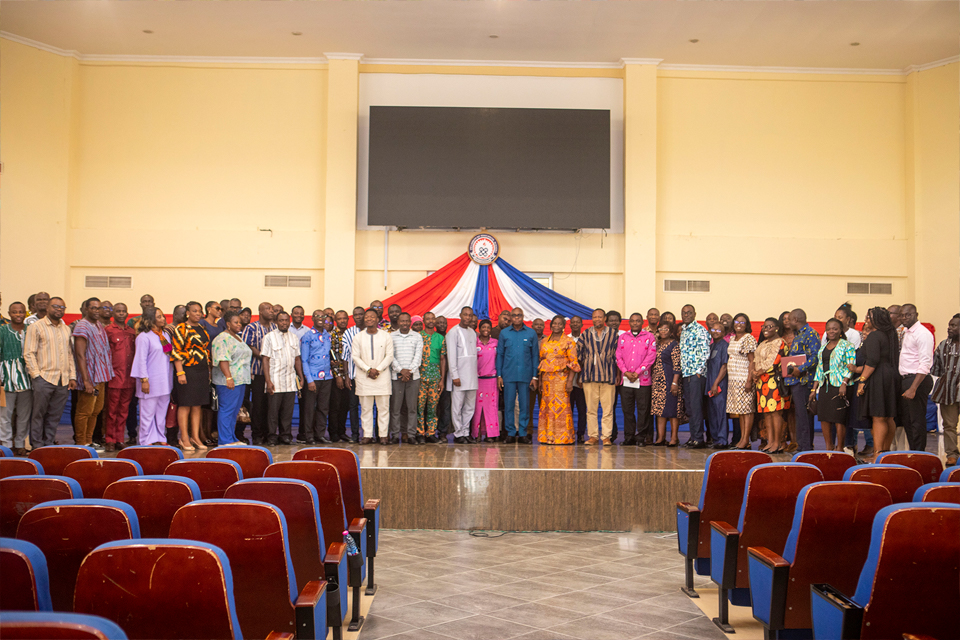
Mr. Okeugo made the remarks during a one-day seminar on institutional branding, global competitiveness and university rankings organised by the Directorate of Research, Innovation and Development (DRID) in collaboration with the Division of Human Resource at the North Campus Mini-Conference Room on Wednesday, 20th May, 2026.
Addressing participants, he observed that the Vice-Chancellor’s introductory remarks reflected a clear institutional direction and demonstrated that UEW was already taking deliberate steps towards strengthening its global reputation and academic visibility.

Drawing on his experience working with universities across 31 countries in Sub-Saharan Africa, Mr. Okeugo observed that African universities including UEW possess the intellectual capacity and innovative potential comparable to globally renowned institutions. According to him, the major difference lies not in capability but in how institutions strategically amplify and communicate their achievements to the international community.
He noted that many African universities often fail to publicise groundbreaking innovations, allowing valuable research outputs and institutional accomplishments to remain unnoticed internationally. Citing an experience at the 2024 World Academic Summit in Manchester, he contrasted how universities in developed countries rapidly commercialise and promote innovations with the tendency among some African institutions to keep similar projects confined within laboratories and internal discussions.
Mr. Okeugo encouraged UEW to intentionally build a strong institutional identity and position itself as a recognisable global academic brand. “Visibility is about how widely a university is known while reputation is about what the university is known for,” he explained, stressing that both elements are critical for attracting international partnerships, donor funding, top researchers and high-quality students.
He urged every member of the university community to become a “brand evangelist” by consistently promoting UEW’s strengths during conferences, academic engagements and professional interactions. He further highlighted university rankings as an important strategic tool for building institutional visibility and credibility. He explained that global ranking systems such as the Times Higher Education World University Rankings and the Impact Rankings help institutions benchmark themselves internationally and attract global opportunities.
Using examples from Africa and Southeast Asia, Mr. Okeugo recounted how universities with strong visibility and ranking performance had secured international partnerships, funding opportunities and major industry collaborations.
Explaining the methodology behind the Times Higher Education World University Rankings, Mr. Okeugo stated that research-intensive universities must meet minimum publication thresholds to qualify for ranking positions. He noted that institutions are assessed across five major pillars: teaching, research environment, research quality, industry engagement and international outlook.
He revealed that based on available Scopus data UEW has already surpassed the eligibility benchmark for the upcoming 2021–2025 cycle. He described the University’s publication trajectory as highly encouraging. He, however, cautioned that many universities undermine their ranking performance through fragmented data management systems, poor coordination among departments and inconsistent institutional branding.
Sharing experiences from universities in East and West Africa, he explained that some institutions fail to submit comprehensive data because departments do not respond promptly to requests for information. In some cases, he noted, smaller but better organised universities have overtaken larger institutions in global rankings due to stronger internal coordination systems. He, therefore, called on UEW to institutionalise effective data management practices and ensure that institutional information remains accurate, verifiable and readily accessible.
The Times Higher Education official also underscored the importance of institutional affiliations in research publications. He warned that universities frequently lose global visibility when researchers omit or incorrectly state their institutional identities in scholarly publications. He encouraged UEW to strengthen its institutional journals, improve editorial standards and work towards securing Scopus indexation for more university journals to enhance research visibility.
On the Times Higher Education Impact Rankings which assess universities based on their contributions to the United Nations Sustainable Development Goals (SDGs), Mr. Okeugo observed that UEW already undertakes significant impact-driven initiatives through teacher education, community engagement and outreach programmes. He advised the university to strategically document and publicise such initiatives through compelling institutional storytelling, photographs, case studies, websites and social media platforms.
Mr. Okeugo concluded by encouraging UEW to continue strengthening its research culture, institutional visibility, strategic communication and global engagement efforts to enhance its international reputation and competitiveness.