UEW Alumnus Wins Top Innovator Award for Modernising Agriculture Education



Kow Aboagye-Ghunney, an alumnus of the University of Education, Winneba (UEW) and a science teacher at West Africa Senior High School (WASS) has been honoured with a prestigious Young Innovator Award for his transformative work in modern agriculture education.
He received the top prize in the agriculture category at the 2025 awards ceremony organised by the Springboard Road Show Foundation under the Mastercard Foundation–supported Ghana Grows programme.
His achievement was further reinforced at the 41st National Farmers’ Day celebration, where he was named Best Innovative Farmer for the La Nkwantanang Madina Municipal Assembly. Both recognitions highlight his leadership in climate-smart agriculture, youth empowerment and practical science education.
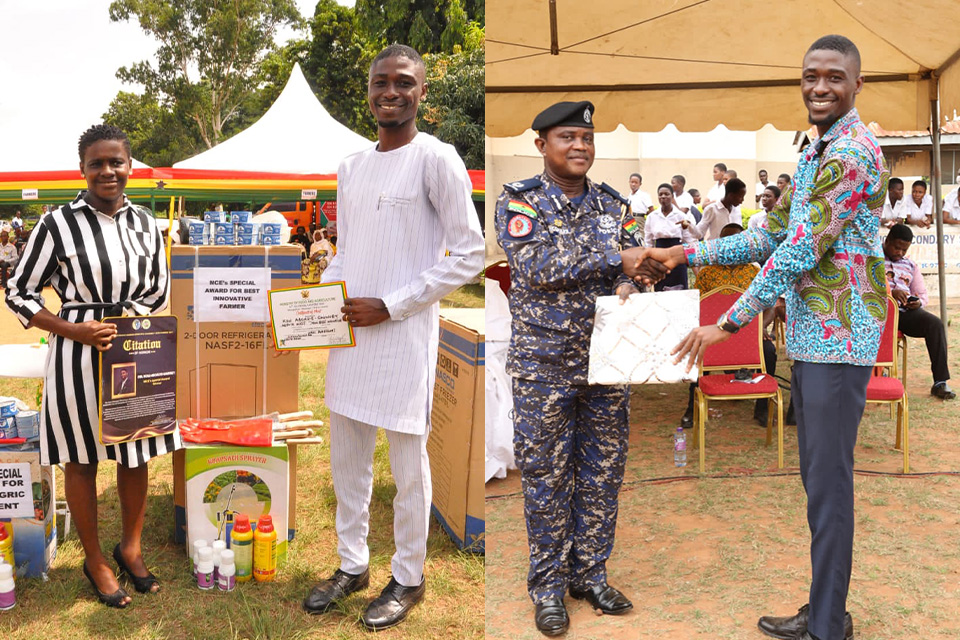
Aboagye-Ghunney has earned national attention for bridging the gap between theory and practice. At WASS, he established a school farm that uses modern technology to teach students climate-resilient farming methods, agribusiness skills and sustainable food production. “Our goal is to make agriculture appealing and relevant to young people. We are showing students that farming is now driven by technology, data and innovation,” he said after receiving the award.
A 2016 Biology Education graduate of UEW, Aboagye-Ghunney has consistently applied his solid pedagogical training to improve learning outcomes. Through mentoring, creative teaching methods and after-school support, he has helped boost WASSCE performance and earned the school’s Best Teacher Award in both 2023 and 2024.
Beyond the classroom, he leads several community-focused initiatives. His school farm serves as a training hub for students and local farmers, offering hands-on experience in climate-smart agriculture. Under his Ghunney Foods brand, he supports home gardeners and farmers with seedlings and farm produce. He also champions environmental stewardship, leading plastic waste segregation and recycling activities on campus.
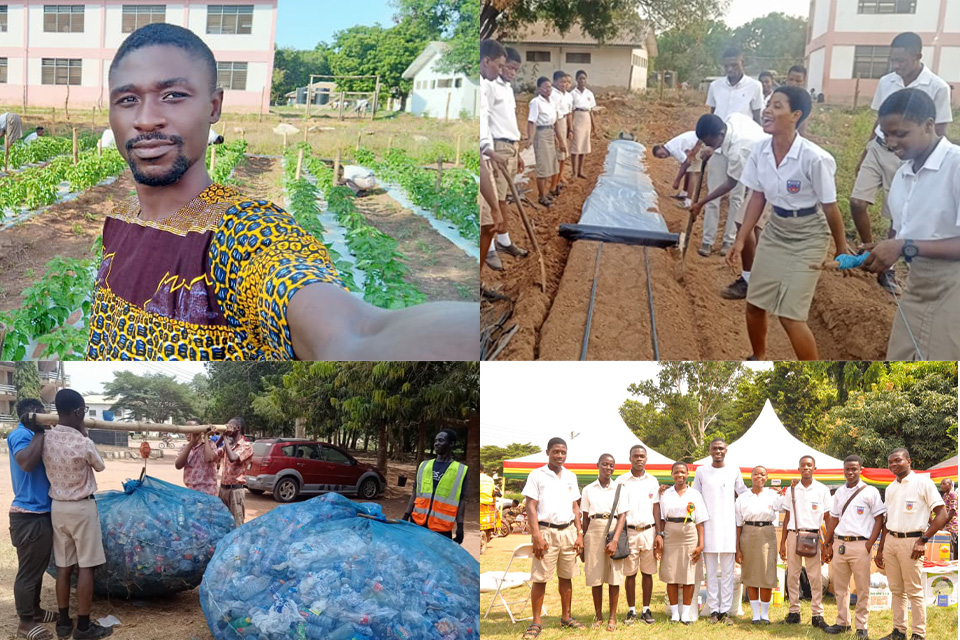
As a STEM coach, he guided students to develop a biodigester that converts waste into clean energy—a project that gained national recognition at the 2024 STEMnovation Competition. His broader vision is to build a fully green school model: reducing waste, recycling plastic, generating biogas for cooking and electricity and using biodigester effluents as manure for the school farm. This approach demonstrates a functional circular economy in an educational setting.
Kow Aboagye-Ghunney’s accomplishments show how innovative teaching and community engagement can transform agriculture education. His work proves that the classroom can be a powerful space for developing practical solutions to real-world challenges.
PROFILE OF KOW ABOAGYE-GHUNNEY — UEW ALUMNUS
Kow Aboagye-Ghunney is a distinguished educator, agripreneur, and STEM innovation coach whose work is redefining science education and sustainable agriculture in Ghana. A proud alumnus of the University of Education, Winneba (UEW), he earned his Bachelor of Science in Biology Education in 2016, a training that grounded his career in strong pedagogy, scientific rigour and a passion for experiential learning.
He currently teaches Science and Biology at West Africa Senior High School (WASS) and lectures with both the University of Cape Coast College of Distance Education (UCC-CoDE) and the UEW College of Distance Education (UEW-CoDEL). In these roles, he teaches courses in Environmental Biology, Agriculture and Pedagogy. He also holds an MPhil in Botany, further deepening his expertise in plant sciences and environmental studies.
Kow’s career is marked by excellence and transformative impact. He was named Best Teacher at WASS in 2023 and 2024, a recognition of his outstanding instructional practice and his remarkable success in improving students’ performance in Biology. Through hands-on practical work, inquiry-based lessons, digital learning tools and a strong focus on scientific literacy, he has significantly enhanced students’ understanding and achievement in the subject.
His commitment to environmental responsibility extends beyond the classroom. At WASS, he leads a plastic segregation and recycling programme that equips students with knowledge and skills in waste management, circular-economy principles and environmental stewardship. This initiative has contributed to a cleaner school environment and inspired many students to champion sustainability.
In agriculture, Kow is equally outstanding. At the 41st National Farmers Day celebration, he was adjudged the Best Innovative Farmer for the La Nkwantanang Madina Municipal Assembly, in recognition of his leadership in climate-smart agriculture and youth empowerment. He manages a model school farm at WASS, where he cultivates vegetables, raises high-quality seedlings for farmers, provides agronomic services and trains young people in modern, technology-driven farming practices. His work integrates drone technology for field monitoring, precision application and student demonstrations—making the school farm a hub for hands-on learning in smart agriculture.
As a STEM coach, he led his students to develop the award-winning “Waste to Watts” project—a biodigester system that converts organic waste into clean cooking gas and electricity. The innovation earned national recognition, placing 11th out of nearly 250 schools in the 2024 STEMnovation Challenge. The project is currently being refined into a functional waste-management system for school and community use, demonstrating Kow’s commitment to solving real-world problems through practical science.
Kow is a Fulbright TEA winner, a Young Innovators Prize winner at the Springboard Roadshow 25 and author of a research publication on heavy metals in rice from Northern Ghana. His work reflects a unique blend of scientific expertise, creativity, community development and youth mentorship.
As an alumnus of UEW, Kow credits much of his professional excellence to the transformative education, mentorship and leadership preparation he received at the University. He remains committed to advancing science education, promoting environmental sustainability, expanding youth participation in agribusiness and driving innovation to support Ghana’s development.