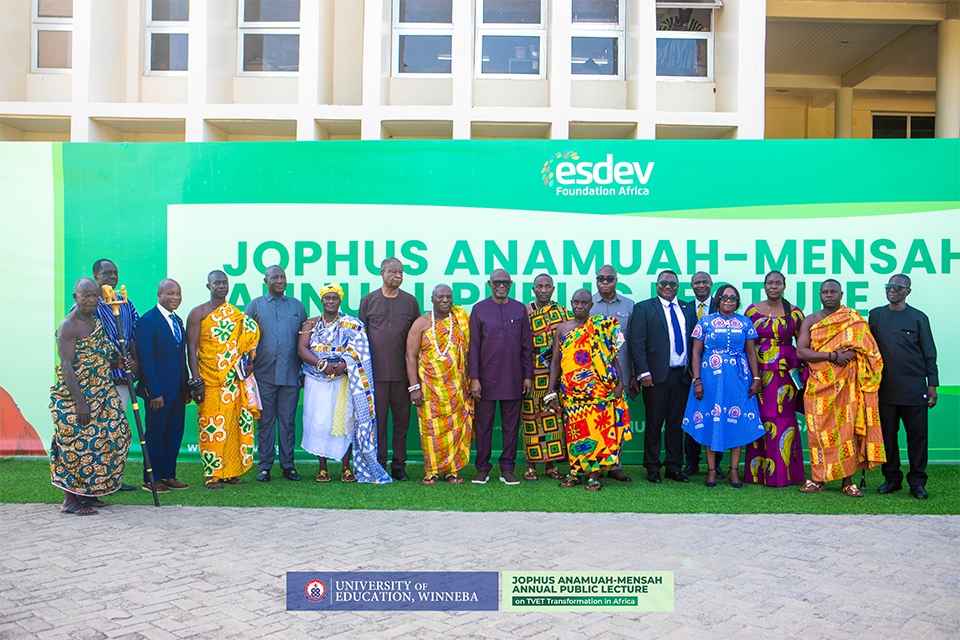
Prof. Tagoe Positions TVET as Africa’s “Strategic Imperative” at Anamuah-Mensah Lecture



Prof. Emer. Clifford Nii Boi Tagoe, a former Vice-Chancellor of the University of Ghana, has described the transformation of Technical and Vocational Education and Training (TVET) as a “strategic imperative” for Africa’s economic future. He urged governments and stakeholders to reposition skills development at the centre of national planning.
Delivering the keynote address at the maiden Jophus Anamuah-Mensah Annual Public Lecture on TVET Transformation in Africa at the Jophus Anamuah-Mensah Conference Centre, University of Education, Winneba (UEW), on Friday, 27th March, 2026, Prof. Tagoe emphasised that Africa’s ability to harness its youthful population depends largely on building a skilled, industry-ready workforce.
He warned that the continent’s demographic advantage could quickly become a liability if education systems fail to equip young people with relevant, market-driven skills. “Every year, millions of young Africans enter the labour market yet many lack the skills that match economic needs. This is not a failure of the youth but a failure of systems,” he stated.
Prof. Tagoe noted that although TVET has existed in Africa for over a century, dating back to colonial-era trade and technical schools, its potential has not been fully realised due to structural and perception challenges. He cited Ghana’s Takoradi Technical Institute, established in 1909, as an early example of formal skills training alongside traditional apprenticeship systems that have long supported the development of the informal sector.
Despite these foundations, he observed that vocational pathways have historically been undervalued in favour of academic education, a legacy that continues to shape public attitudes and policy priorities.
According to him, Africa currently faces a critical paradox of “graduates without jobs and jobs without skilled workers,” driven by weak alignment between education systems and labour market demands. He stressed that industries across sectors, including manufacturing, construction, agribusiness and renewable energy, require competent technicians and artisans who are in short supply.
“TVET is not a fallback option; it is the engine of economic transformation when properly governed, adequately funded and closely linked to industry needs,” he asserted.
Prof. Tagoe highlighted ongoing continental efforts to address these challenges, referencing the African Union’s Continental Strategy for TVET (2025–2034), which aims to guide member states in tackling unemployment, promoting sustainable development and enhancing employability.
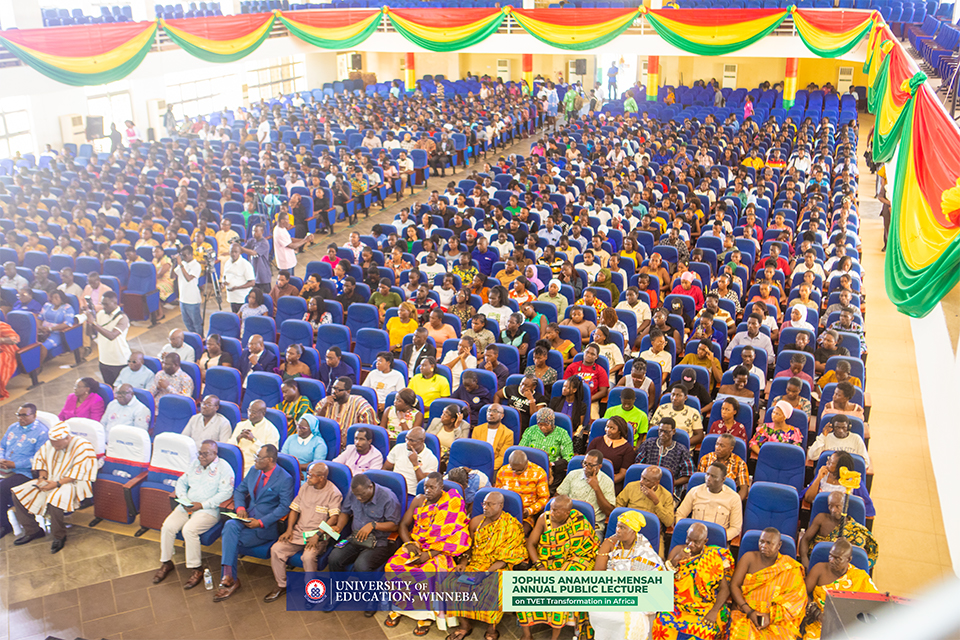
Using Ghana as a case study, he outlined significant reforms undertaken in recent years to reposition TVET. These include the establishment of coherent governance structures through legislation such as the Pre-Tertiary Education Act (2020), which created the TVET Service to oversee pre-tertiary technical institutions.
He noted that these reforms have improved coordination, strengthened accountability and expanded access with enrolment in TVET institutions rising significantly, from fewer than 20,000 annually before 2017 to over 60,000 in recent years and total enrolment exceeding 150,000 learners.
A major shift, he explained, has been the adoption of Competency-Based Training (CBT) which focuses on practical skills acquisition and aligns training with industry standards. “CBT ensures that what matters is not how long learners sit in classrooms but what they can actually do,” he said.
He cautioned that significant challenges remain including infrastructure deficits, the high cost of implementing competency-based training and the need for continuous professional development for instructors. Public perception, he added, continues to be a major barrier. “TVET is still often viewed as inferior to academic education and until we change this mindset, our reforms will remain incomplete,” he observed.
Prof. Tagoe proposed a four-pillar approach to advancing TVET transformation: strengthening governance and coordination, improving curriculum relevance and quality assurance, deepening industry engagement through work-based learning and addressing societal perceptions of vocational careers.
Reflecting on the broader African context, he described TVET transformation as a “social contract” that requires commitment from governments, universities, industries and communities. “Africa stands at a critical point where its future depends on skilled hands, innovative minds and practical problem solvers,” he said.
He urged stakeholders across the continent to draw lessons from Ghana’s experience while adapting reforms to their specific contexts. He noted that transformation is a continuous and complex process.
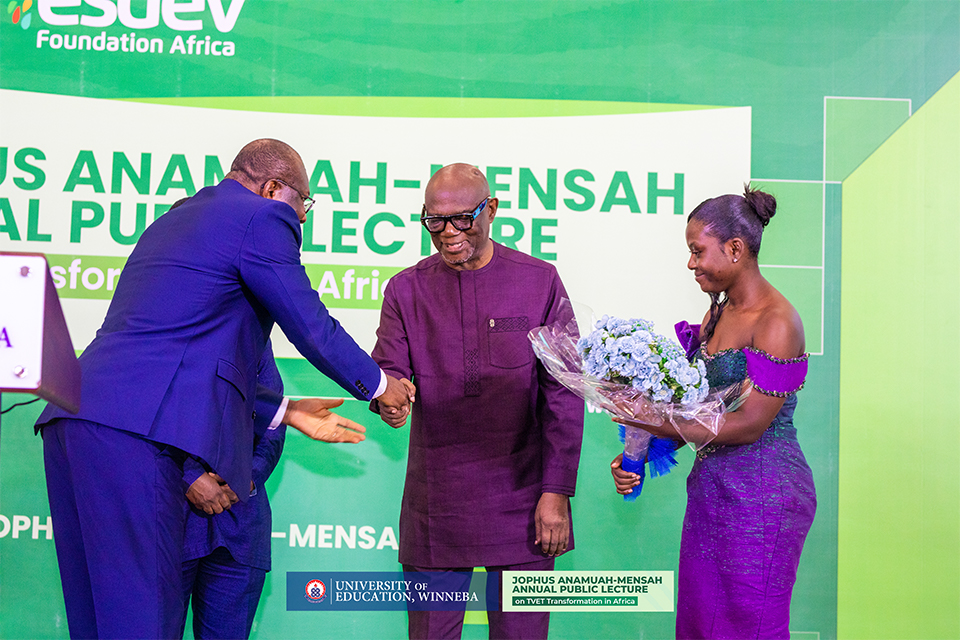
Prof. Tagoe also paid tribute to Prof. Jophus Anamuah-Mensah, the honouree of the lecture, commending his leadership and contributions to Ghana’s education reforms, particularly his role in the National Education Strategic Plan (2018–2030).
The lecture formed part of an initiative to stimulate high-level dialogue and policy engagement on skills development. The event was organised by the Education and Skills Development (ESDEV) Foundation Africa, in partnership with the University of Education, Winneba; University of Cape Coast; University of Skills Training and Entrepreneurial Development (USTED); Accra Technical University; African Institute for Mathematical Sciences (AIMS) Ghana; Vice-Chancellors Ghana; and Transforming Teaching, Education and Learning (T-TEL).