
Call for Abstracts: 9th International Multidisciplinary Conference for Postgraduate Students
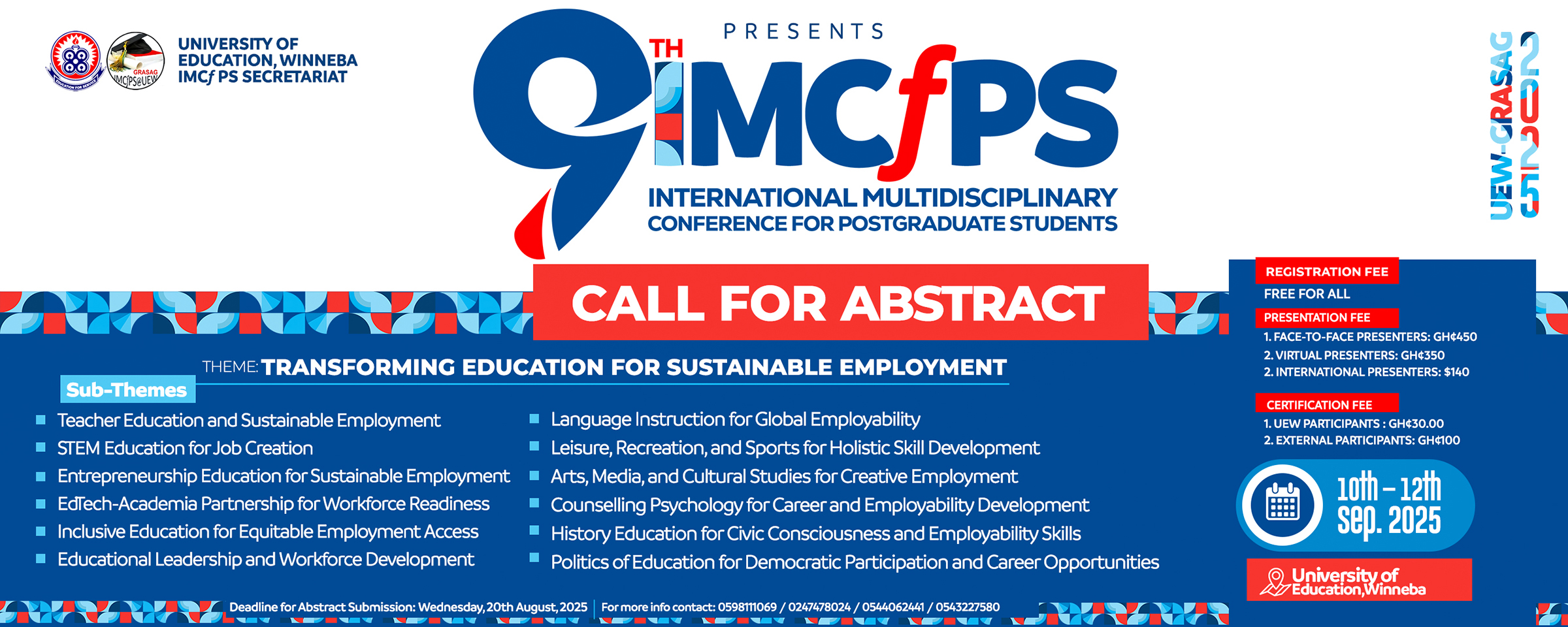
Call for Abstracts: 9th International Multidisciplinary Conference for Postgraduate Students
The Graduate Students Association of Ghana at the University of Education, Winneba, in collaboration with the IMCfPS Secretariat, invites the general public to submit abstracts for presentation at its 9th International Multidisciplinary Conference for Postgraduate Students this year. Details are as follows:
Theme: Transforming Education For Sustainable Employment
In the rapidly evolving digital landscape, education systems worldwide are undergoing significant transformation. The integration of Artificial Intelligence (AI) into teaching and learning processes is reshaping how educators are prepared and deployed, requiring new competencies, policy frameworks, and collaborative models. According to UNESCO (2023), leveraging AI in education offers vast opportunities to enhance teaching efficiency, personalize learning, and optimize workforce development, but it also demands robust policies and ethical safeguards to ensure equity and sustainability. At the same time, global institutions such as the World Economic Forum (2023) emphasize the urgent need to align education with the demands of the future workforce, noting that 44% of workers’ skills will be disrupted within the next five years, and that educators must be equipped to prepare learners for AI-driven economies. The OECD (2022) also advocates for stronger collaboration between governments, educational institutions, and industries to create inclusive, future-ready teacher education systems.
In Ghana, ongoing education reforms, such as the implementation of the Standards-Based Curriculum (SBC), the Common Core Programme (CCP), and the National Pre-Tertiary Curriculum Framework, reflect national efforts to align curriculum and teacher education with 21st-century demands. These reforms emphasize competency-based learning, digital literacy, and entrepreneurship to ensure learners are not only academically proficient but also equipped with practical, employable skills. Against this backdrop, the conference theme underscores the urgent need for innovation in education, responsive policy development, and collaborative stakeholder engagement. The conference seeks to explore how education can be reimagined to foster digitally skilled, globally-minded, and employment-ready graduates capable of contributing meaningfully to national and global development.
Sub-Themes:
The theme of the conference may be approached from (but not limited to) the following disciplinary and theoretical perspectives:
- Teacher Education and Sustainable Employment
- STEM Education for Job Creation
- Entrepreneurship Education for Sustainable Employment
- EdTech-Academia Partnership for Workforce Readiness
- Inclusive Education for Equitable Employment Access
- Educational Leadership and Workforce Development
- Language Instruction for Global Employability
- Leisure, Recreation, and Sports for Holistic Skill Development
- Arts, Media, and Cultural Studies for Creative Employment
- Counselling Psychology for Career and Employability Development
- History Education for Civic Consciousness and Employability Skills
- Politics of Education for Democratic Participation and Career Opportunities
Submission of Abstracts
We invite you to submit an abstract of 250 words or less on any of the above sub-themes or in line with the conference theme for paper presentation and panel discussion.
Please include a brief bio-data detailing the author’s name and institutional affiliation to the Planning Committee via imcfps@uew.edu.gh
Format for Abstract Submission
All submissions must be in double spacing in Microsoft Word, Times New Roman 12-point font, with a left margin of 3cm and all other margins of 2cm. PDF submissions will not be accepted for review. Full-refereed papers and working papers are accepted from prospective presenters.
Presentation Modes
- Standard Presentation (GH₵ 450)
Standard presentations are face-to-face, classroom-style presentations.
Standard presentations are scheduled for 25 minutes each. Your presentation should be a maximum of 15 minutes, with the remaining 10 minutes allocated for Q&A.
- Virtual Presentation (GH₵ 350)
Virtual presentations are online presentations, done via a secure online platform (Zoom). It is scheduled for 25 minutes each. Your presentation should be a maximum of 15 minutes, with the remaining 10 minutes allocated for Questions & Answers.
Deadlines for Submission
- Abstract: 20th August, 2025
- Final feedback for Abstracts: 23rd August, 2025
- Payment of Conference Fee: 31st August, 2025
- Printing of Book of Abstracts: 5th September, 2023
Registration package for Presenters includes:
- Potential Publication of full paper in IMJRE - Journal (2025)
- E-brochure with abstracts for virtual presenters, hard copy for standard presenters
- Certificate of presentation
- Participation in a panel discussion
- Participation in a social network
Additional Benefits for face-to-face presenters include:
- T-Shirts
- NotePad and Pens
- Feeding
- Coffee Break
Registration package for non-presenters includes:
- Certificate of Participation - (GH₵ 30)
- Coffee Break
For further information, please contact:
- Prof. Charles K. Assuah, Chairman: ckassuah@uew.edu.gh
- Prof. Akwasi Kwarteng Amoako-Gyampah, Co-Chairman: akamoako-gyampah@uew.edu.gh
- Mr. Williams Frimpong, Committee Secretary: imcfps@uew.edu.gh / 0598111069
- Mr. David Kwaku Xefu, UEW-GRASAG President: 0247478024