UEW Lecturer Presents Research on Ghana Disaster Blog Coverage at SCMS Retreat



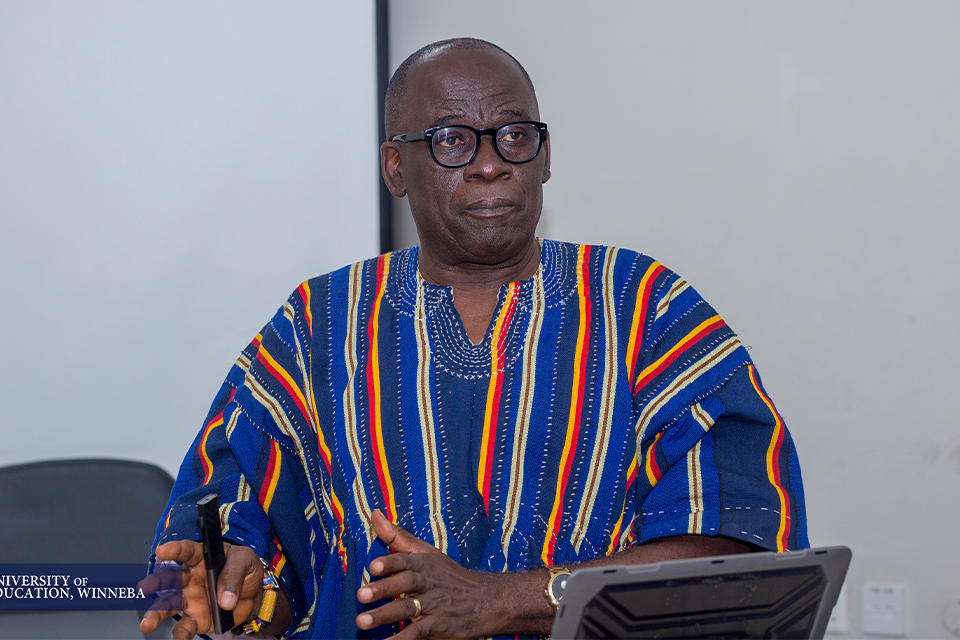
Dr. Elizabeth Owusu Asiamah, a lecturer at the Department of Journalism and Media Studies, has presented research on how Ghanaian blogs reported disasters, focusing on the 2022 Apiate chemical explosion, during the School of Communication and Media Studies (SCMS) faculty retreat held at the Students Centre Seminar Room III.
Dr. Elizabeth Asiamah explained that her interest in the subject was triggered by a major national incident that occurred in January 2022. She interrogated how the media assigned relevance and prominence to the event. According to her, the rapid expansion of media technologies, particularly the internet has significantly transformed news production and consumption, leading to the rise of social media platforms and alternative media such as blogs, which increasingly serve as primary sources of news for many audiences.
Dr. Elizabeth Asiamah noted that her scholarly focus on blogs was influenced by her earlier doctoral research on gatekeeping and gatewatching which highlights the growing role of bloggers and alternative media as agenda-setters operating outside traditional media institutions. She explained that existing literature recognises blogs as platforms capable of influencing public discourse by prioritising issues that may receive limited attention from mainstream media.
Drawing on disaster communication scholarship, she outlined the conceptual understanding of disasters as sudden catastrophic events that result in loss of life and property. She distinguished between natural disasters—such as floods, earthquakes and hurricanes—and man-made disasters, including explosions, industrial accidents and transportation crashes. She observed that disaster coverage represents a critical area of media responsibility due to its implications for public safety, prevention and post-disaster management.
As a case study, Dr. Elizabeth Asiamah examined the Apiate chemical explosion, which occurred on January 20, 2022, at Bogoso in the Western Region of Ghana. She recounted that the explosion destroyed dozens of buildings, claimed approximately 17 lives and displaced about 3,000 residents, attracting widespread attention from both mainstream and alternative media at the local and international levels.
She explained that her study sought to investigate how blogs, identified as major online news platforms, covered the Apiate explosion, noting that while several studies exist on blog coverage of politics, racism, conflicts and protests, there is limited documented research on how Ghanaian blogs report disasters. Given the increasing reliance on blogs for fast and accessible news, she argued that their framing of disaster events can significantly influence public understanding and response efforts.
The study focused on the coverage of the explosion by two Ghanaian blogs, Ghpage.com and Ghbase.com, and was guided by three research questions: the level of prominence accorded to the explosion stories, the sources of the reports and the frames employed in narrating the incident. She explained that the research was anchored in agenda-setting theory and framing theory, which examine how media influence what audience think about and how they interpret issues.
Methodologically, Dr. Elizabeth Asiamah adopted a qualitative research approach, employing qualitative content analysis to examine 31 news stories published by the selected blogs over a one-month period from January 20 to February 20, 2022. She explained that although the explosion occurred on a single day, extending the period of analysis aligned with scholarly recommendations to examine patterns of prominence and framing over time
Using frequency as a key indicator of salience, she analysed how often the explosion was reported and how narrative emphasis was employed to prioritise the disaster for the audience. Through this process, she identified emerging patterns in the ways blogs framed the incident and assigned importance to different aspects of the disaster.
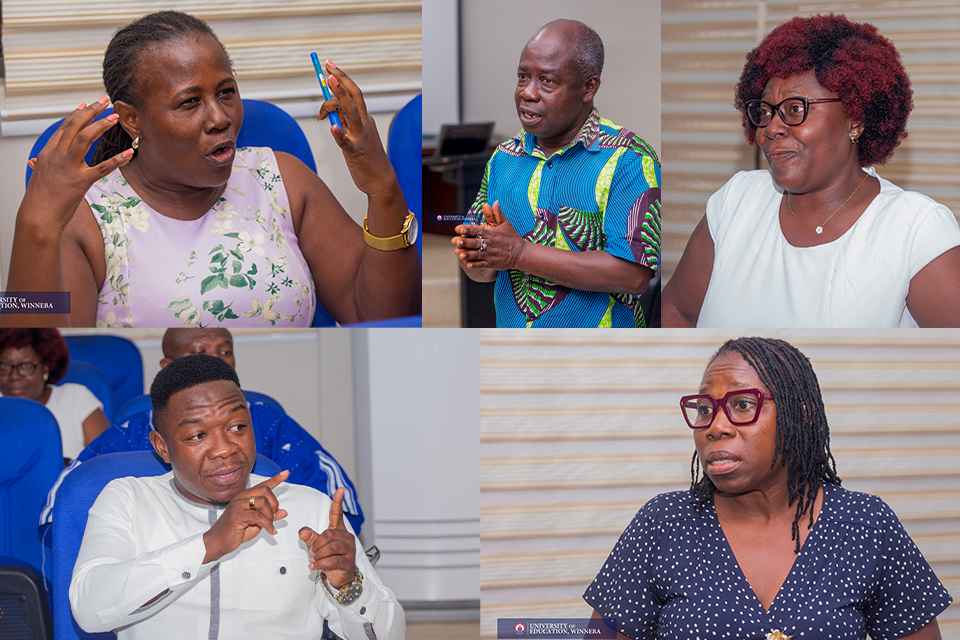
Her presentation generated scholarly engagement among faculty members and reinforced the relevance of alternative media research within contemporary communication studies, particularly in the context of disaster reporting and digital news consumption.
The SCMS faculty retreat provided an important forum for faculty members to showcase ongoing research, exchange ideas and strengthen the School’s collective commitment to advancing scholarship, teaching and research in communication and media studies in line with the mission of the University of Education, Winneba.