UEW Hospital Earns B+ in First GHS Regional Peer Review



The University of Education, Winneba (UEW) Hospital has scored 75.1%, equivalent to a B+, in its first peer review assessment conducted by the Regional Health Directorate (RHD) of the Ghana Health Service (GHS), Central Region.
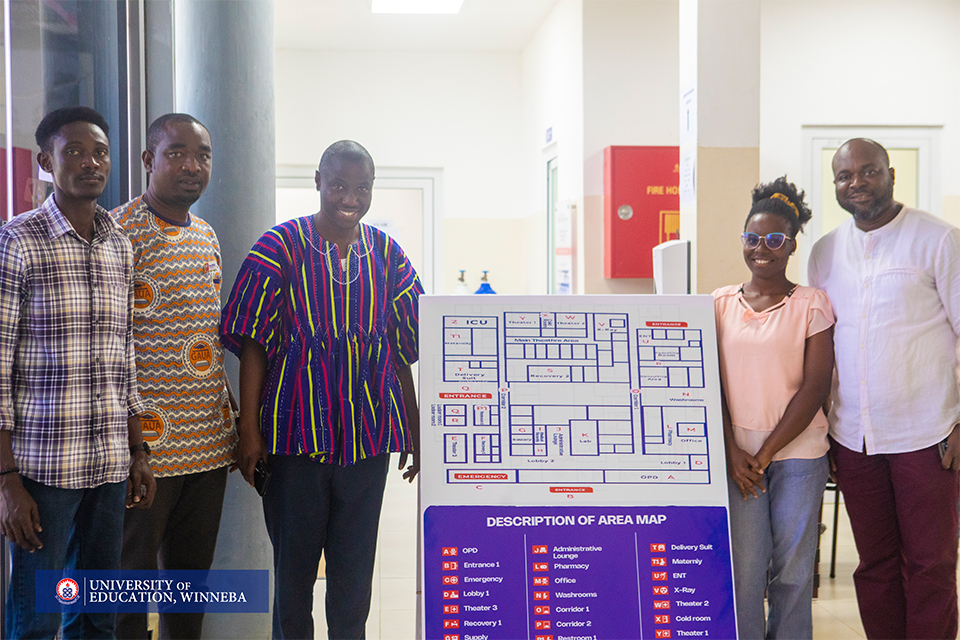
The assessment by a team of regional assessors on Thursday, 27th August, 2026, formed part of the GHS’ standardised hospital-to-hospital peer review system for evaluating the quality of health service delivery.
The review covered nine modules, namely environment and infrastructure, infection prevention and control, emergency services and systems, quality and safety management system, clinical practice, client care, occupational health and safety, governance and the Regional Director’s mark.

Speaking after the exercise, Dr. John Kanyiri Yamba, the Director of the University Health Services Directorate (UHSD), described the assessment as a significant step towards establishing an objective measure of the hospital’s performance.
He said the standardised assessment provided the University Hospital with an external benchmark against which its performance could be measured as opposed to the previous situation where there was no external assessment of the facility.
Dr. Yamba said the result demonstrated that the Hospital was a moderately performing health facility and commended the entire team, particularly the heads of the various units, for achieving the result on their first attempt.
He, however, acknowledged the gaps identified during the exercise and assured that the Hospital would take the recommendations seriously and work to improve its performance in the next assessment. “We will address the challenges identified and improve health care for the people who come to visit us,” he said.

Rev. Prosper Eric Ocran, the Regional Estate Manager of the Central Regional Health Directorate, GHS, who was part of the assessment team, said the peer review was designed to assess hospitals against a common standard and evaluate the quality of service delivery.
He expressed satisfaction with the performance of the University Hospital, noting that the facility, which is about a year and a half old, had achieved a moderate performance standard on its first assessment.
According to him, the 75.1% score represented the second-highest category within the performance classification and reflected the Hospital’s strong showing in the assessment.
Rev. Ocran also commended the University’s management for agreeing to participate in the peer review and urged the Hospital to sustain its efforts towards improving its services.
He noted that the assessment team had identified some gaps, particularly in emergency services, which required attention. These included protocols and preparedness for handling mass casualty situations such as stampedes and referrals involving critically injured people.
He said the relevant gaps including those relating to referral arrangements and emergency response, had been outlined for the Hospital to address to strengthen service delivery.
The assessment therefore provides the University Hospital with a benchmark for consolidating its strengths and addressing identified gaps as it works towards improved performance in subsequent peer reviews.