
UEW Equips Student Leaders for Responsible Leadership and Quality Enhancement



The University of Education, Winneba (UEW) has equipped newly elected student leaders with practical governance, ethical leadership, digital responsibility and quality assurance skills to strengthen their contribution to student representation and institutional development.
The training formed part of a three-day Student-Leadership Training Workshop organised by the Office of the Dean of Student Affairs (ODSA) from Wednesday, 16th to Friday, 18th September, 2026, at the Jophus Anamuah-Mensah Conference Centre, North Campus.
Held on the theme, “The Student-Leader as Part of University Management: Responsibilities and Cautions,” the workshop focused on preparing student leaders to champion legitimate student interests while contributing to the University’s vision and objectives.

Addressing the student leaders, Rev. Canon James Andoh-Appiah, an Assistant Registrar at ODSA, urged them to lead with discipline, humility, accountability and a profound sense of responsibility. He reminded them that leadership offers a unique arena to serve, learn and build a lasting legacy that will shape their future professional and public lives.
He further stressed the need for effective time management, responsible handling of association finances and adherence to appropriate channels in addressing academic, social and administrative concerns. He also urged leaders to maintain accurate records of correspondence, meetings, assets and official activities to promote accountability and ensure continuity in their organisations.

On digital responsibility, Mr. Boakye Agyeman, the Head of Hosting Services and Systems Administration and Principal ICT Assistant, said contemporary student leadership required a sound understanding of digital systems and responsible technology use.
He explained that student leaders often serve as a link between their colleagues and the University’s digital service providers, particularly on matters involving academic results, accommodation, online assessments, clearance and institutional communication. He therefore advised them to distinguish genuine technological challenges from issues requiring referral to the appropriate University offices.
Mr. Agyeman also cautioned leaders against spreading unverified information and exposing students’ personal data through digital platforms. He encouraged responsible use of artificial intelligence. He noted that while AI could support research, brainstorming, organisation and other tasks, users remained responsible for understanding and verifying information generated by such systems.
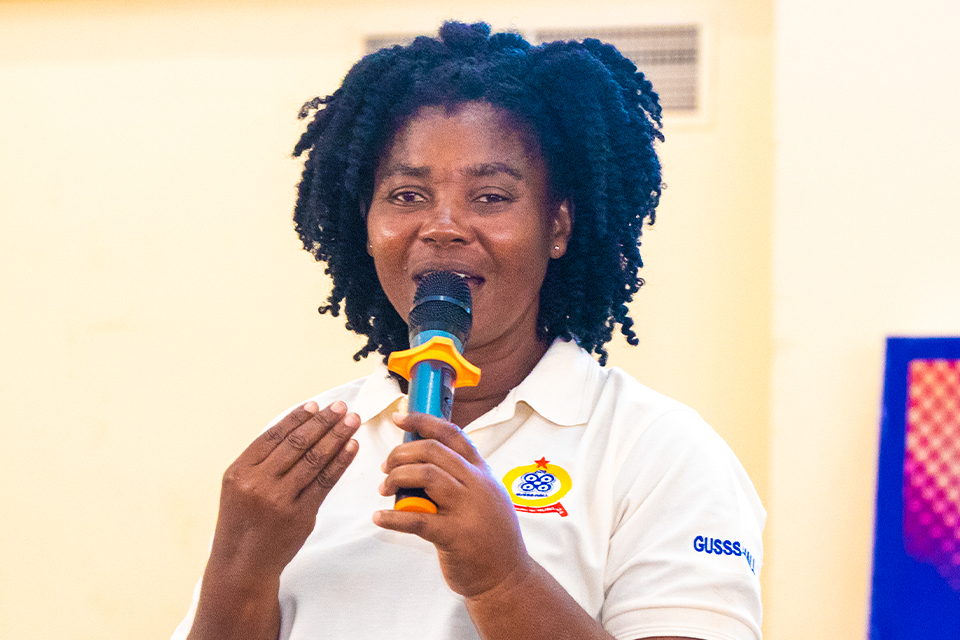
Dr. Vivian Acquaye, Vice-Dean of Student Affairs, challenged the student leaders to familiarise themselves with and comply with the University’s bylaws. She noted that the bylaws, like national laws, were intended to promote an environment conducive to teaching, learning, student welfare and peaceful coexistence. She urged student leaders to lead by example and cautioned against conduct such as fighting, drug-related offences, excessive noise-making, unauthorised trading and other activities that could undermine the academic environment.
Dr. Vivian Acquaye further encouraged the leaders to exercise restraint in resolving disagreements and use appropriate institutional channels rather than their positions to intimidate or take advantage of fellow students.

Dr. Medina Srem-Sai, the Head of the Department of Quality Assurance, broadened the discussion by positioning student leaders as partners in quality assurance and institutional improvement.
She explained that student leadership extended beyond representation, advocacy and welfare to include a responsibility to help the University continuously improve the quality of its education and services. She noted that students were key stakeholders because they directly experienced teaching, learning, assessment, facilities and support services.
Dr. Medina Srem-Sai urged leaders to provide feedback that was factual, specific, respectful, evidence-based, timely and solution-oriented. She also called for objectivity and integrity in student evaluations, cautioning against using such processes for revenge or for personal attacks.
She further cautioned against rushing to social media with incomplete or unverified information, urging them to “verify before you amplify.”
The workshop reinforced student leaders' role as responsible partners in University governance, quality improvement and institutional development. It encouraged them to combine effective representation of student interests with accountability, ethical conduct, digital responsibility and constructive engagement with University authorities.


